Hands-On, Safe, and Nationally Recognised: Manual Handling Training at VASS College: Building the Skills That Keep Carers and Clients Safe
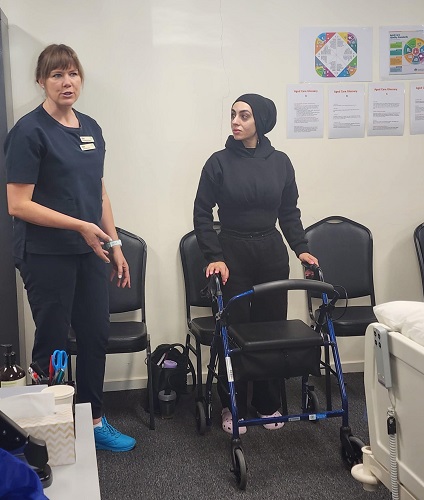
A qualified OT demonstrates safe manual handling techniques using a rollator walker VASS College, Broadmeadows.
At VASS College
We are committed to preparing our students not just with theoretical knowledge, but with the real world, hands on skills that make a genuine difference in their careers and in the lives of the people they will care for.
Last week, our Certificate III in Individual Support students participated in a dedicated Manual Handling Training session, delivered on site at our Broadmeadows campus by a qualified Occupational Therapist (OT). The session covered the nationally recognised unit of competency FBPOPR2074, Carry Out Manual Handling Tasks, equipping our students with the critical knowledge and practical skills to move and assist people safely, confidently, and in accordance with Australian workplace health and safety standards.
Every student who attended the session received a Certificate of Participation in Manual Handling Training, a meaningful recognition of their commitment to professional development and safe practice.
What Is Manual Handling Training?
Manual handling refers to any activity that requires a person to lift, lower, push, pull, carry, move, hold, or restrain a person, animal, or object. In the Individual Support and aged care sector, manual handling is one of the most fundamental and potentially hazardous tasks that support workers perform on a daily basis.
When done incorrectly, manual handling can result in serious injury to both the support worker and the person being assisted. Musculoskeletal injuries related to poor manual handling are among the most common workplace injuries in Australia’s care sector. This is precisely why proper training is not optional; it is essential.
VASS College’s Manual Handling Training session, aligned with the nationally recognised unit FBPOPR2074, teaches students how to:
Assess the risks associated with manual handling tasks in a care environment
Apply safe manual handling principles and body mechanics when assisting clients
Correctly operate manual handling equipment, including hoists, slings, transfer aids, and bed rails
Safely transfer a person between a bed, a wheelchair, and a standing position
Respond appropriately to unexpected situations during a manual handling task
Maintain dignity, comfort, and safety for the person being assisted at all times
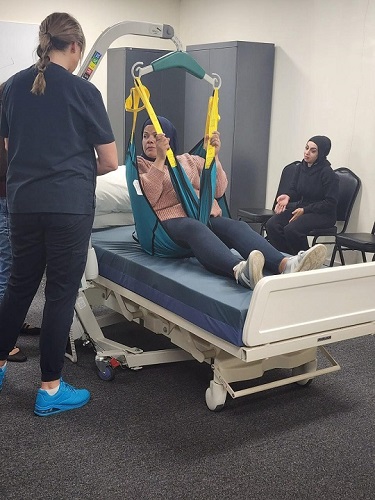
Students practise the hoist and sling technique on the adjustable hospital bed.
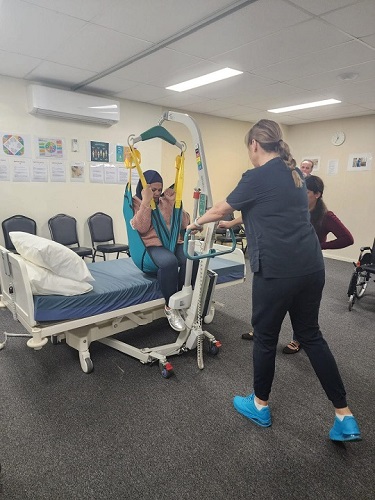
The OT guides a student through a safe patient lift using the electric hoist.
Delivered by a Qualified Occupational Therapist
One of the distinguishing features of VASS College’s Manual Handling Training is that it is delivered by a qualified Occupational Therapist (OT), a healthcare professional with specialist expertise in movement, function, and the safe management of people with disability or limited mobility.
Our OT facilitated a structured, interactive session that moved students through each stage of manual handling practice in a safe, clinical grade training environment. With professional grade equipment including electric hoists, slings, transfer belts, adjustable hospital beds, rollator walkers, and wheelchairs, students had the opportunity to practise every technique hands on, rotating through both the support worker role and the client role to understand the experience from both perspectives.
This dual perspective approach is a hallmark of high quality care training. When a support worker has experienced what it feels like to be lifted, transferred, or repositioned, they develop a deeper sense of empathy, and a far greater commitment to doing it properly.
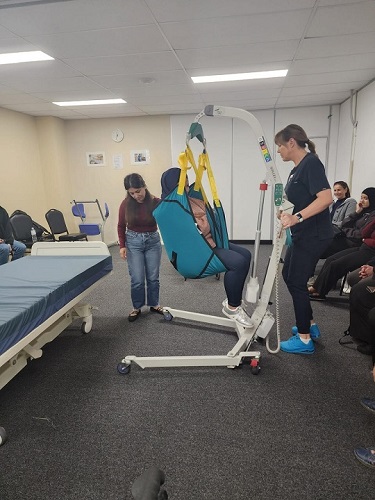
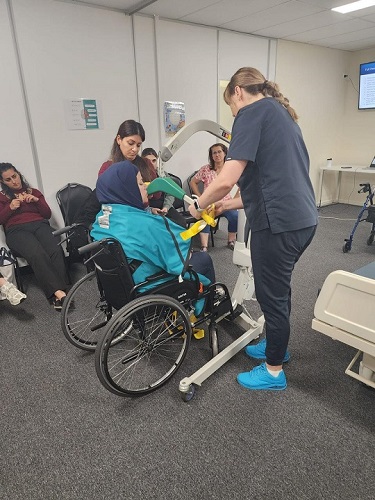
A student is safely lifted in the hoist sling as peers observe the full transfer technique.
Transferring from a hoist to a wheelchair, students learn every stage of the movement process.
What the Session Covered: Key Practical Skills
Hoist and Sling Operation
Students learned how to correctly fit and position a full-body sling, operate an electric hoist safely, and guide a person through a complete lift from a supine position on the bed to a seated position in a wheelchair. This is one of the most technically demanding manual handling tasks in aged and disability care, and students approached it with great focus and care.
Bed Based Transfers and Repositioning
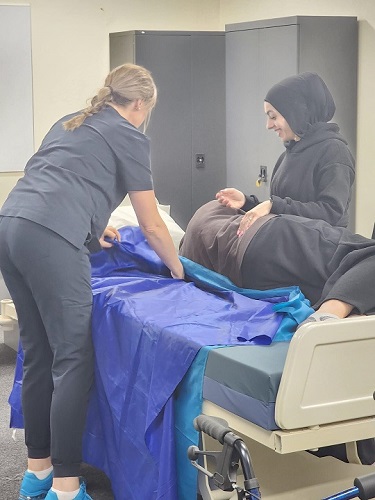
The session also covered bed-based manual handling, including how to safely reposition a person who has slid down the bed, assist a person to sit up, and use slide sheets to reduce friction and protect both the client and the worker during movement. Students practised fitting and using slide sheets with confidence by the end of the session.
Wheelchair Transfers and Walking Aids
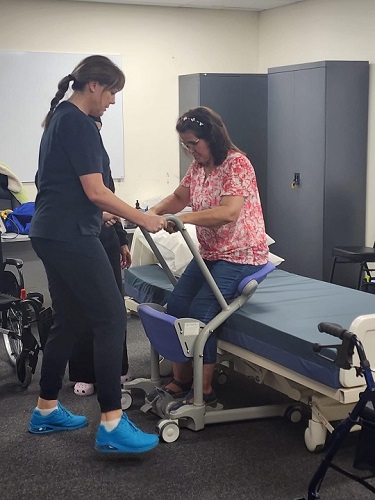
Students practised transferring a person from a standing position into a wheelchair using correct body mechanics, as well as assisting a person to safely use a rollator walker. The correct use of transfer belts and the importance of verbal communication with the client throughout every movement were emphasised throughout.
Safety First Legislation and Risk Assessment
Beyond the practical skills, students were introduced to the legislative framework underpinning manual handling in Australian workplaces, including the Work Health and Safety Act 2011 and relevant codes of practice. Understanding their legal obligations and their duty of care is a foundational part of becoming a professional support worker.
Practising bed-based repositioning techniques using slide sheets for safe, friction-free movement.
Assisted sit to stand transfer using a transfer pole building confidence in both student and client.
Certificates of Participation Awarded
At the conclusion of the training session, every student who attended received a Certificate of Participation in Manual Handling Training. This certificate is a formal recognition of the student’s engagement with the nationally recognised unit FBPOPR2074 and their commitment to developing safe, professional practice in their Individual Support studies.
For our students, many of whom are preparing to enter the workforce in aged care, disability support, and community services, this certificate represents more than just a document. It represents a commitment to the people they will one day care for, a promise that they will handle every transfer, every lift, and every moment of physical assistance with skill, respect, and care.
Why Manual Handling Training Matters
Safe Work Australia Key StatisticsMusculoskeletal disorders related to manual handling account for approximately 37% of all serious workplace injuries in Australia's health and community services sector. Proper training is the most effective intervention to reduce these injuries.
For students studying Certificate III in Individual Support, Manual Handling Training is not simply a box to tick; it is a foundational pillar of competent, safe, and person centred care. The skills developed in this session will be called upon in every shift, with every client, in every care environment our graduates work in.
At VASS College, we are proud to go beyond the minimum. By engaging a qualified OT to deliver this training with real equipment in a real clinical environment, we ensure that our students are not just theoretically prepared; they are practically ready.
Conclusion: Training That Makes a Real Difference
Last week’s Manual Handling Training session was a vivid reminder of what great vocational education looks like in practice students fully engaged, equipment in hand, learning skills that will protect themselves and the people in their care for the entire span of their careers.
To every student who participated: well done. Your Certificate of Participation is well earned, and the skills you have developed are ones you will carry with you into every care environment you enter. At VASS College, we are proud to have been part of that journey.